
Vrishabh
Agentic AI Equity Analyst for the Indian Investor


What it is
Vrishabh is an autonomous AI equity analyst built specifically for the Indian retail investor — a class of market participant historically locked out of the kind of research infrastructure that institutional desks take for granted.
The platform merges two proprietary subsystems: Suvarn, a regime-aware technical analysis engine capable of detecting market state, scoring signals across five conviction levels, and recognizing 20+ chart and candlestick patterns — and Paqshi, a dual knowledge graph encoding India's macro-financial structure (NSE companies, conglomerates, RBI/SEBI policy, sector relationships, FDI/FPI flows) alongside a global geopolitical intelligence graph (trade conflicts, sanctions, supply chain shocks, technology disruptions).
Rather than presenting raw data to the user, Vrishabh synthesizes all of this into a reasoning agent that acts before the user asks: generating morning market briefs every three hours, monitoring custom watch conditions, and enriching every query with live TA context and graph traversal before formulating a response.
Why I'm building it
India has roughly 90 million active DEMAT account holders. Fewer than 2 million of them have access to research-quality analysis — the kind that HNI clients get from brokerages. Everyone else is left with free screeners that show raw data but offer no synthesis, or robo-advisors that do passive allocation and nothing tactical.
Bloomberg terminals cost ₹20,000–50,000 a month. SEBI-registered advisors come with conflicts of interest and a five-figure annual retainer. The gap between "I have data" and "I understand what to do with it" is enormous, and no product in the Indian market is seriously trying to close it for the retail investor.
Vrishabh started as an exploration of whether a tightly integrated agentic system — one that reasons across TA signals, macro structure, news sentiment, and portfolio context simultaneously — could approximate the analytical depth of a research desk at zero marginal cost to the user. It also gave me a real reason to work through the harder problems in agentic design: tool reliability, evidence grounding, hallucination control, memory injection, and building proactive behavior that doesn't feel like noise.
How it works(High-Level)
Vrishabh is built as a layered intelligence pipeline. Each layer adds structure to raw data before it reaches the reasoning agent.
Signal Layer (Suvarn TA Engine):
Continuously processes OHLCV data for 100+ NSE tickers every two minutes during market hours. Runs regime detection to classify market state (trending, ranging, reverting), then computes composite scores across momentum, volume, pattern recognition, and support/resistance dimensions. Signals are suppressed in sideways or uncertain regimes — the engine only fires when conviction is meaningful.Knowledge Graph Layer (Paqshi):
Two static-but-rich graphs. The India graph maps structural relationships: which conglomerates own which businesses, how RBI policy propagates through sectors, which companies have FDI exposure. The global graph encodes live geopolitical dynamics and their downstream market implications. The agent traverses these graphs contextually — a question about Reliance doesn't just return TA data, it also pulls relevant conglomerate linkages, sector dependencies, and macro policy context.Reasoning Agent (VrishabRLM):
A custom multi-stage reasoning loop operating in three modes. Quick mode runs a planner-execute-analyst chain with no live tool calls, latency under 20 seconds. Agent mode pre-enriches the question with per-ticker TA data and broad market context before the LLM sees it. Deep mode runs a full agentic loop — up to seven rounds of tool calls, with a live reasoning trace streamed to the frontend so users can see exactly what evidence shaped the answer.Autonomous Scheduler:
Operates independently of any user session across three concurrent loops: market sync every two minutes, news sentiment scoring every hour, and morning brief generation every three hours. After each market sync, a watch condition agent evaluates user-defined alert thresholds against fresh TA data and fires SSE notifications when conditions are met.
Performance
Backtested across diversified Nifty 50 baskets with 0.1% commission per leg, Suvarn's composite signal strategy has consistently delivered 38–63% CAGR across tested 2–5 year windows in the 2019–2025 range. The primary edge isn't return amplification — it's drawdown compression. The strategy captures roughly 80% of bull market upside while avoiding the worst of the COVID and rate-hike cycle drawdowns, where a passive buy-and-hold saw 52–84% peak-to-trough losses.
Gallery / Demo
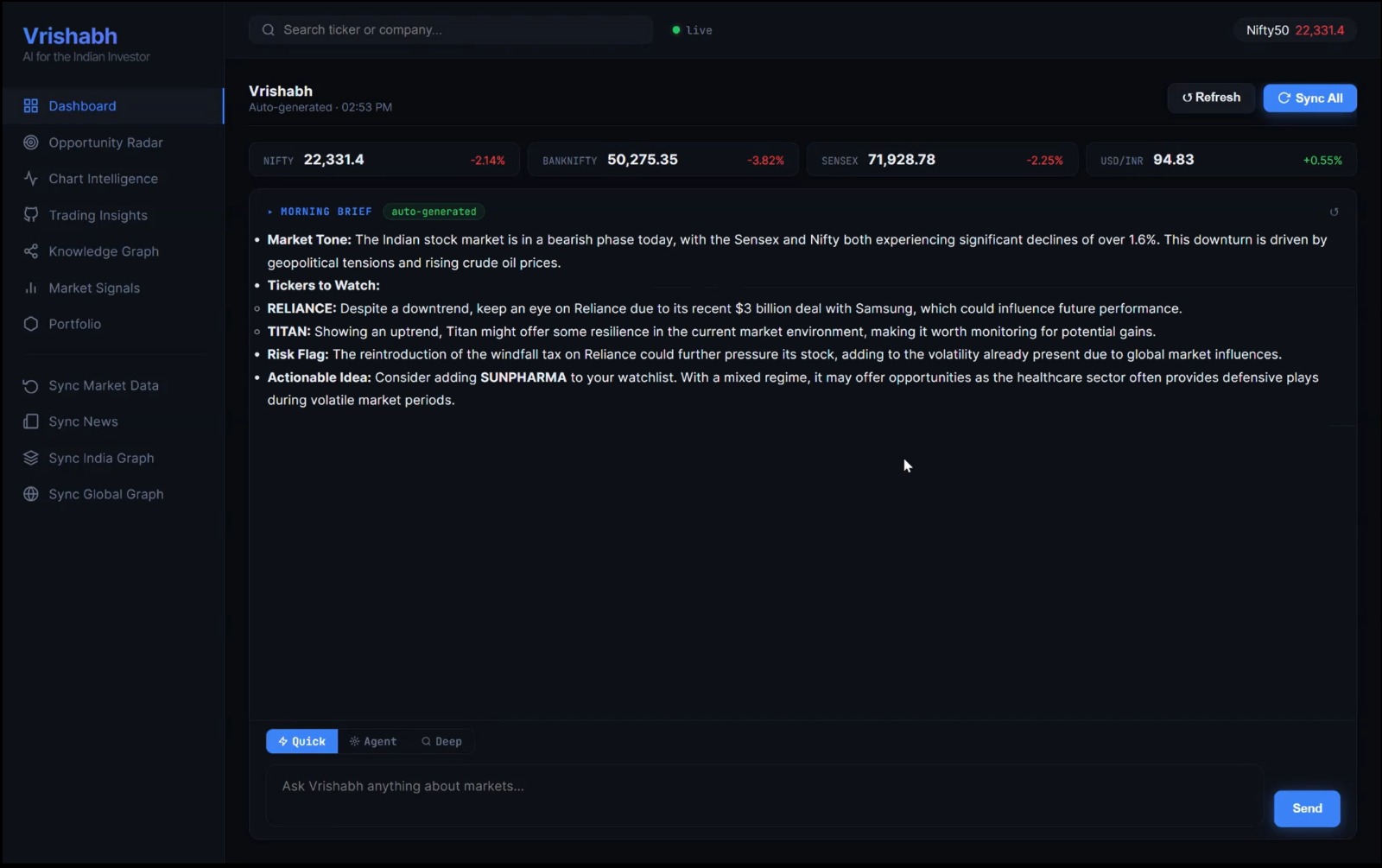
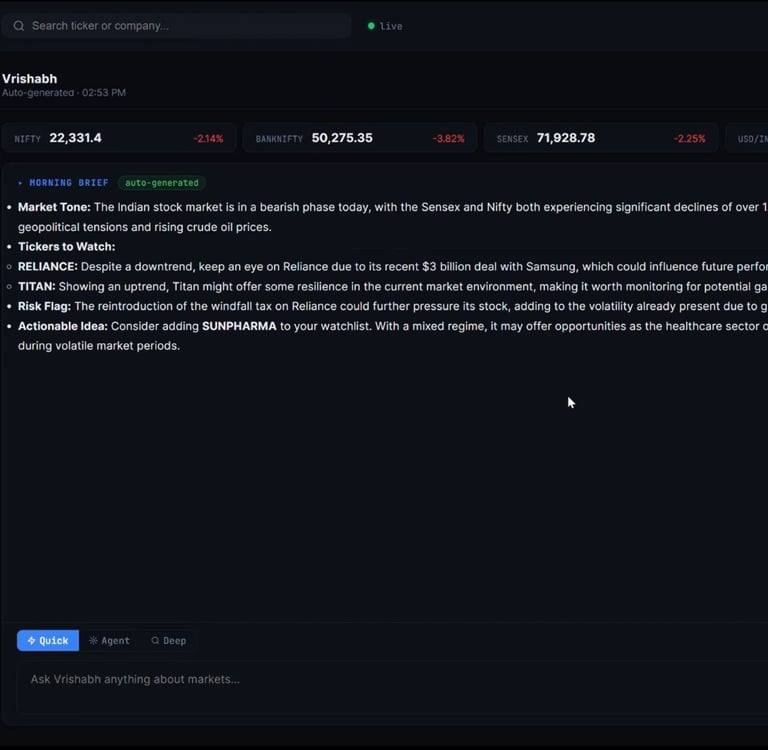
Agent Dashboard
Demo Video